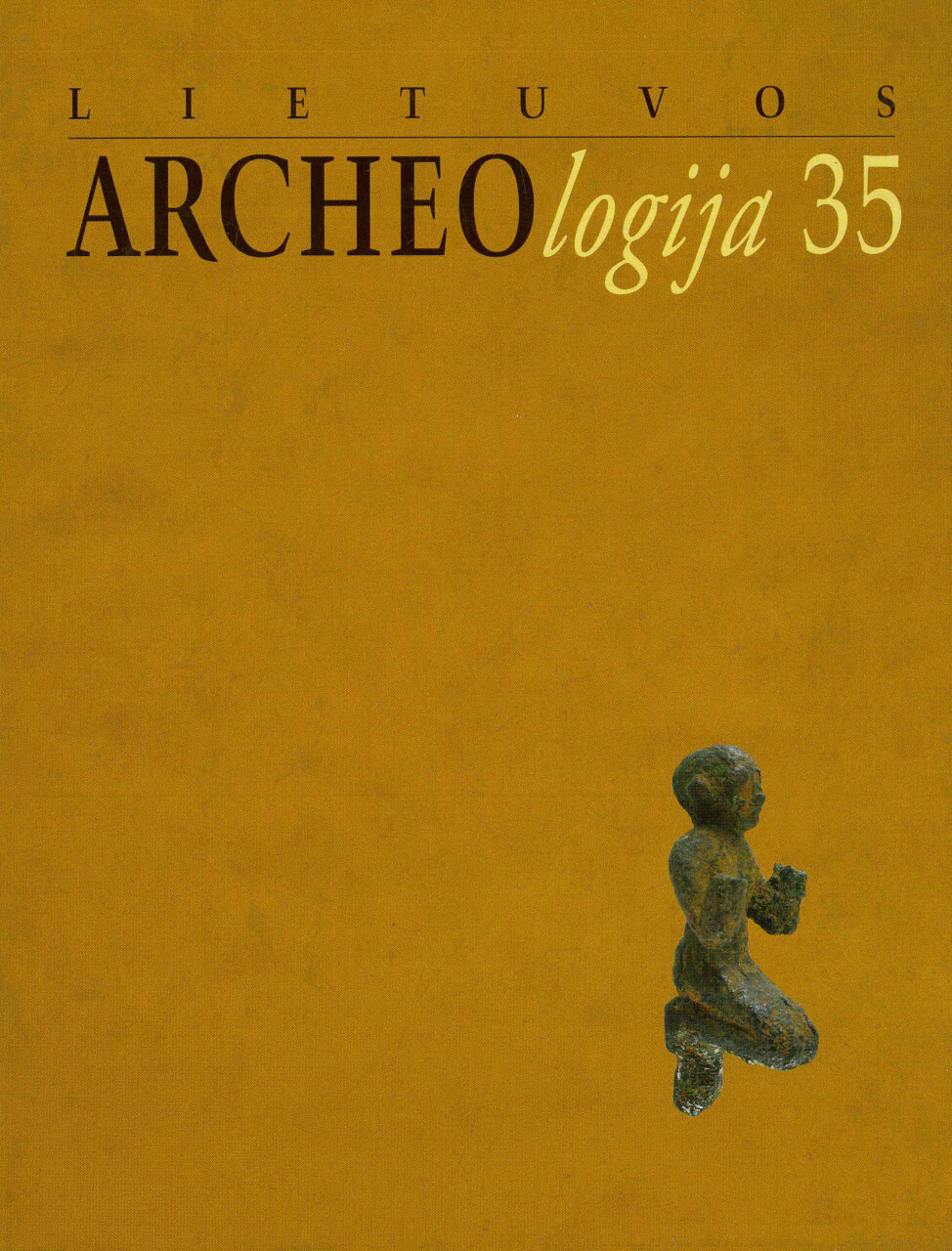
Journal:Lietuvos archeologija
Volume 35, Issue 1 (2009): Lietuvos archeologija, pp. 9–36
Abstract
On the basis of surviving archive documents and the recollections of contemporaries, the article recreates the history of the serial research publication Lietuvos Archeologija (Lithuanian Archaeology) from the appearance of the need to have a separate archaeological publication in Lithuania to the release of volume 1 of Lietuvos Archeologija. This volume passed through four development phases: the appearance of the conception (late 1974–early April 1975), the materialisation of the idea in the form of plans (April–June 1975), its preparation in the Department of Archaeology (second half of 1975– second half of 1977), and its preparation for publication at Mokslas Publishing House (second half of 1977–late April 1979). Consistent studies of Soviet era archaeological history are hindered by the incompleteness of the available sources and the lack of comprehensiveness of the information recorded in them.
Journal:Lietuvos archeologija
Volume 35, Issue 1 (2009): Lietuvos archeologija, pp. 37–52
Abstract
This article is devoted to one aspect of the cultural activity of the Ancker timber merchants from Rusnė (Russ), namely their amateur interest in local prehistory and archaeological artefacts. In 1879 Johann Heinrich Ancker and his son, Ernst Heinrich, became members of the Lithuanian Literary Society in Tilsit. The society’s journal Mitteilungen der Litauischen litterarischen Gesellschaft briefly describes artefacts, which E. H. Ancker had called to the attention of the society’s members. Later (in 1887) these finds or some of them were donated to the Prussia Museum in Königsberg. Ancker also became a member of Altertumsgesellschaft Prussia. In 1891 the brothers, Ernst and Theodor Ancker, introduced Professor A. Bezzenberger to a few of the archaeological sites they knew in Šilutė (Heydekrug) District. Unfortunately we do not know what archaeological artefacts E. H. Ancker preserved privately in his house in Šyškrantė (Rusnė).
Journal:Lietuvos archeologija
Volume 35, Issue 1 (2009): Lietuvos archeologija, pp. 53–70
Abstract
The article is devoted to the person of Petras Tarasenka (1892–1962) and the history of his most important archaeological work Lietuvos Archeologijos Medžiaga (Lithuanian Archaeological Material) (published in Kaunas, 1928). It presents information about this digest and map of Lithuanian archaeological sites, the course and results of the work’s preparation for publication, and the public’s reaction after its release. It draws the conclusion that Lietuvos Archeologijos Medþiaga is the result of P. Tarasenka’s greatest personal efforts, that his objective was to contribute to the nurturing of the national culture, and that the archaeological map of East Prussia with commentary (published in Berlin, 1908) that was prepared by Emil Hollack (1860–1924) should be considered the work’s prototype.
Journal:Lietuvos archeologija
Volume 35, Issue 1 (2009): Lietuvos archeologija, pp. 71–82
Abstract
Interest in the heritage of Ancient Egypt has been constantly increasing in Lithuania since the 16th century. It was initially just amateur artefact collecting, which was very common among Lithuanian noblemen. Egypt began to be scientifically investigated in the 19th century. The first research publications were issued and the foremost Lithuanian excavations were conducted at this time. The early 1920’s are considered to be the beginning of modern Egyptology in Lithuania and should be associated with M. Rudzinskaitė-Arcimavičienė, who was especially interested in archaeological investigations and the latest discoveries in Egypt.
Journal:Lietuvos archeologija
Volume 35, Issue 1 (2009): Lietuvos archeologija, pp. 83–94
Abstract
Archaeology was one of the most important Nazi propaganda tools. Heinrich Himmler created the organization, SS – ‘Ahnenerbe’, which gathered researchers in an attempt to prove Germany’s right to the area they were occupying. The Nazis conducted investigations throughout Germany, including East Prussia. The investigations conducted during 1935–1937 in Stary Dzierzgoñ were one of the most important actions taken at that time.
Journal:Lietuvos archeologija
Volume 35, Issue 1 (2009): Lietuvos archeologija, pp. 95–116
Abstract
During the Soviet period, Lithuanian archaeologists developed a highly descriptive tradition in Lithuanian archaeology. In post-Soviet Lithuania, archaeologists continue to practice the descriptive tradition and rarely engage in theoretical debates. In order to understand the evolution of the descriptive tradition in Lithuanian archaeology, we provide an evolutionary analysis of current trends in Lithuanian archaeology. The overall goal of the article is to generate discussion between archaeologists about Lithuanian archaeology’s past, present and future.
Journal:Lietuvos archeologija
Volume 35, Issue 1 (2009): Lietuvos archeologija, pp. 127–136
Abstract
Pirmasis archeologijos periodinis leidinys Baltarusijoje pasirodë 1928 metais. XX a. 3 ir 4 dešimtmetyje Baltarusijos mokslas buvo pasiekęs europinį lygį. Sovietmečiu nebuvo išleista nė vieno specializuoto archeologijos mokslo periodinio leidinio. Šiuo metu Baltarusijoje leidžiami trys skirtingo periodiškumo archeologiniai leidiniai – „Istorinis–archeologinis rinkinys“, „Baltarusijos archeologijos medžiaga“ ir „Acta archaeologica Albaruthenica“.
Journal:Lietuvos archeologija
Volume 35, Issue 1 (2009): Lietuvos archeologija, pp. 137–142
Abstract
The article reviews the most important periodicals publications on archaeological research in Estonia during 1990–2008. The growth in the number of publications has also started to regulate and stabilize archaeological literature in Estonia. The success of these processes lies with the archaeologists working at the Institute of History and Archaeology of the University of Tartu, the Institute of History of the Tallinn University and the National Heritage Board.