Journal:Lietuvos archeologija
Volume 39, Issue 1 (2013): Lietuvos archeologija, pp. 11–40
Abstract
The object of the study is the formation and evolution of territorial units in the Eastern Lithuania in the 1st–15th centuries. On the basis of theoretical framework, investigations of foreign authors and GIS analysis of the development of archaeological sites of Eastern Lithuania, authors validate the model of territorialisation of this region, analyse it‘s evolution in different periods up to the christianisation of Lithuania and beginnings of formation of the network or churches.
Journal:Lietuvos archeologija
Volume 39, Issue 1 (2013): Lietuvos archeologija, pp. 41–52
Abstract
Inspired by a single unique find, this article is devoted to the investigation of the history of splint armour, which was popular in the Middle Ages. It analyses splint armour’s origin, its development, the chronological limits of its occurrence, the tendencies of its geographic spread, and related problem questions. It also thoroughly discusses the surroundings of the rerebrace find spot in Vilnius, the artefact’s material qualities, and the course of its conservation.
Journal:Lietuvos archeologija
Volume 39, Issue 1 (2013): Lietuvos archeologija, pp. 53–72
Abstract
This article is devoted to summarising the new archaeological and parasitological research data accumulated during the last several years of research. The text analyses the living conditions of the inhabitants of the castles in Vilnius, their nutrition and defecation habits, everyday hygiene, the contamination of the environment with parasites, and related problems. It discusses the possibility of identifying endoparasites and ectoparasites in Medieval cultural layers, the subtleties of interpreting the accumulated data, and the importance and perspectives of the results of this research.
Journal:Lietuvos archeologija
Volume 39, Issue 1 (2013): Lietuvos archeologija, pp. 73–96
Abstract
The article analyses the 14th–17th century Alytus community long bone fractures and dislocations. Based on archaeological, historical, and osteological data certain environmental conditions and possible health hazards are assessed including the cause and later consequences of fractures. Analysis demonstrated that Medieval Alytus community was exposed to similar risk of fractures compared with similar Medieval town type communities.
Journal:Lietuvos archeologija
Volume 39, Issue 1 (2013): Lietuvos archeologija, pp. 97–120
Abstract
The article is intended to present and analyze bioarchaeological data from the cemetery of Old Panevėžys (Senasis Panevėžys) (dated to the 16th–17th centuries) in terms of paleodemographical and paleoepidemiological aspects. The material is also compared with large simultaneous Lithuanian skeletal collections from rural, town and urban cemeteries. The relationship between life and death was very close in the community of Old Panevėžys, i.e. due to high mortality rates, the population was characterized by high numbers of young and low numbers of older individuals, respectively. Sex differences in the risk of mortality were fluctuating depending on age. Females in reproductive period had a higher risk of mortality; while those who survived it had a lower risk than contemporary males. Based on demographical and height data, community of Old Panevėžys was more similar to rural rather than to urban populations. In addition, skeletal indicators of biological health capacitated for some plausible explanations for patterns of morbidity and mortality.
Journal:Lietuvos archeologija
Volume 39, Issue 1 (2013): Lietuvos archeologija, pp. 121–144
Abstract
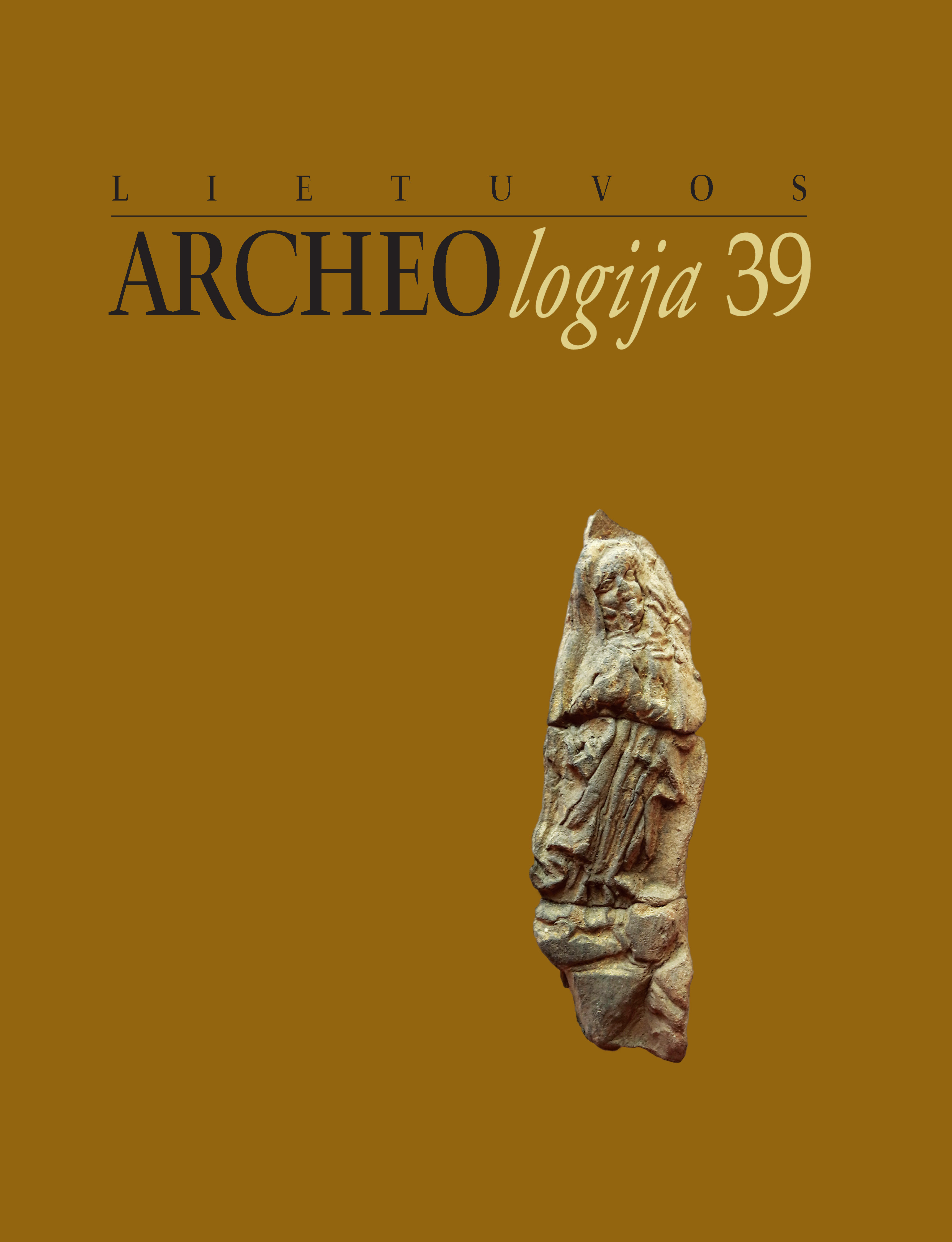
The article presents Klaipėda stove tiles decorated with a religious themes characteristic of the Late Medieval and Pre-Reformation periods. It identifies their subjects and holy personages. On this basis, it divides the tiles into two topical groups and presents similar subject parallels from other European cities. The article discusses the technological – construction features of the tiles, aspects of their formation, and the manifestations of their production in Klaipėda. In order to evaluate the incidence and use of the analysed tiles in the local milieu during the period, it actualises the circumstances of their discovery and the related chronological problems.
Journal:Lietuvos archeologija
Volume 39, Issue 1 (2013): Lietuvos archeologija, pp. 145–176
Abstract
The article analyses the 16th–19th century glass bottle material discovered and collected during archaeological investigations in Klaipėda Old Town and Friedrich Suburb and analyses the environment of its discovery. It pays special attention to the problems of the terminology and the documentation of the artefacts. The article presents the typology, chronology, purpose, and origin of the glass bottles found in Klaipėda. It asserts that the presence of glass bottles can also be an indicator of service sites such as inns, taverns, wine-bars, restaurants, etc. in the city.
Journal:Lietuvos archeologija
Volume 39, Issue 1 (2013): Lietuvos archeologija, pp. 177–234
Abstract
The article presents material from the archaeological investigation of Lithuanian post-war partisan bunkers that existed on the Mikniai family farmstead in Mėnaičiai village and on the Sajai family farmstead in Balandiškis village (Grinkiškis Eldership, Radviliškis District). Eight Lithuanian partisan commanders gathered and conducted meetings in the Prisikėlimas Military District staff bunker constructed under the granary on the Mikniai family farmstead in February 1949. The directive documents for the founding of the Union of Lithuanian Freedom Fighters (LLKS), its statutes, the leadership structure, and the districting system were approved in the meetings. On 16 February the partisan commanders signed the political LLKS Declaration proclaiming that the LLKS council was the supreme political organ of the occupied nation until an independent democratic Republic of Lithuania was re-established. From October 1949 to January 1950, the public section of the LLKS operated in the bunker constructed in the storage barn of the Sajai family farmstead in the autumn of 1949 and published the publication ‘Prie rymančio rūpintojėlio’. The article discusses the types of bunkers used by the Lithuanian partisans fighting against the Soviet occupation, the essential details of their construction, and the sources of information. Its aim is to determine how much archaeological investigations of such sites supplement, correct, and perhaps even change the historical information and that provided by witnesses.
Journal:Lietuvos archeologija
Volume 39, Issue 1 (2013): Lietuvos archeologija, pp. 235–254
Abstract
The article presents instances in Lithuania of the wet sieving of archaeological layers (1983–2011), giving the method’s advantages and disadvantages and discussing the difficulties arising in such investigations, the possible ways of resolving them, and the special features of wet sieving archaeological layers compared to dry sieving. The authors especially focus on the experiences of the expedition excavating Bajorai cemetery (Elektrėnai Municipality). In presenting this expedition’s technical measures, the course of the recording of archaeological finds, the time expenditures, and the resources, the article looks at the wet sieving method from a new perspective and as a necessity during expeditions investigating waterlogged or damp archaeological layers.