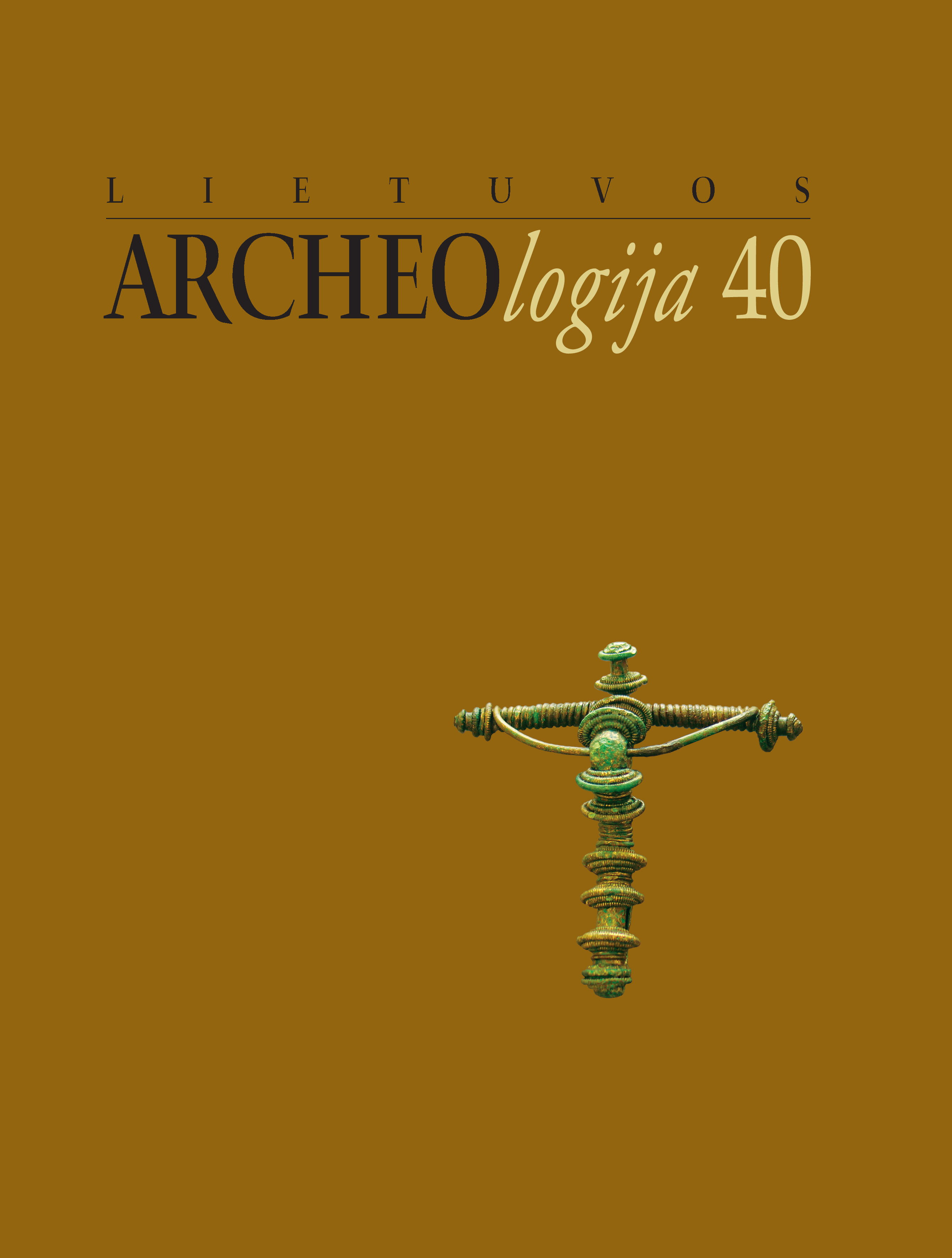
Journal:Lietuvos archeologija
Volume 40, Issue 1 (2014): Lietuvos archeologija, pp. 43–72
Abstract
The article deals with social relationships as reflected in the Roman Iron Age burial material found in Western Lithuania and the Lower Nemunas area. The burial data are considered at three – regional, cemetery and grave levels. The archaeological material is analysed in terms of both quantity and quality. Socio-economic differentiation is detected by the number of artefact types (NAT) discovered in graves. Quality-wise the main method used is that of grave good combinations where an attempt is being made at identifying grave series in view of different grave good combinations by means of correspondence analysis. Where appropriate, the layout of separate grave clusters in the general spatial development of cemeteries was examined. Consistent examination of Western Lithuanian and Lower Nemunas area cemeteries results in detecting the changes that occurred within Roman Iron Age societies, offers information about how a family position is reflected in mortuary data and suggests relationships between communities.
Journal:Lietuvos archeologija
Volume 40, Issue 1 (2014): Lietuvos archeologija, pp. 73–98
Abstract
This article seeks to discuss and create a complex investigation method, which would allow the social structure of a buried community to be evaluated as objectively as possible and would highlight a more universal evaluation of amber artefacts. With the help of the archaeological material from the community buried in Mazkatuži cemetery (West Lithuanian Stone Circle (Kerb) Grave culture), it seeks to illustrate the advantages of a unified method in analysing the community’s social distribution and the valuation of amber artefacts.
Journal:Lietuvos archeologija
Volume 40, Issue 1 (2014): Lietuvos archeologija, pp. 99–138
Abstract
This article surveys grave goods found in Žviliai and Pagrybis Cemeteries in the Upper Jūra region (West Lithuania) as symbols of gender. Using the WinBASP software seriation tool, male and female types of grave goods were distinguished as well as types common to both genders. The author seeks to detect changes and continuity in the burial traditions for males and females in respect to the tradition of placing specific types of grave goods in burials from the three periods (Late Roman Iron Age, Early Migration Period, Late Migration Period). If grave goods are regarded as gender symbols, their choice for males and females probably reflects areas of ‘masculinity’ and ‘femininity’ in real life. This phenomenon can be confirmed with the help of Baltic, Germanic, and Slavonic mythology sources in which the domains of the gods and humans are intertwined.
Journal:Lietuvos archeologija
Volume 40, Issue 1 (2014): Lietuvos archeologija, pp. 139–162
Abstract
In recent decades archaeology has focused increasingly on various insufficiently studied social aspects such as gender, women, children, and childhood. This has led to the creation of a new branch of archaeology: the archaeology of childhood, which studies various questions about children and their life, status, and role in society. Inspired by these new developments, this paper offers an analysis of child burials in the Middle and Late Iron Age (5th–12th century) mortuary landscape, i.e. the network of cemeteries in Latvian territory, an analysis of the disposition and orientation of the child burials, and a discussion of the equal importance of children and adults in society. The paper proposes the hypothesis that age in the period under study played an important role and therefore not every child (presumably infants) was buried in the common cemetery. Older children were fully incorporated in the belief practices of the common society and as prepared for the afterlife as the adults.
Journal:Lietuvos archeologija
Volume 40, Issue 1 (2014): Lietuvos archeologija, pp. 163–179
Abstract
Cremated and non-cremated human remains from fourteen Estonian Iron Age burial grounds were analysed in order to estimate the number of burials in the graves as well as the age at death and sex of the individuals in these burials and to model the demographic "gures for some Estonian Iron Age communities. Three graves (Rõsna I, Rõsna II, Suure-Rõsna) in South-eastern Estonia and two in Western Estonia were suitable for palaeodemographic analyses. Five of the graves were used by communities with 3–9 individuals, which usually corresponds to a single family or household. Rõsna-Saare I barrow cemetery in South-eastern Estonia indicated a somewhat larger community of 10–15 individuals, which could have been an extended family, a larger household, or two nuclear families. The estimated crude death rate during the Middle Iron Age at Rõsna varied between 49.2 and 62.1‰ (52.4‰ on average). The estimated crude death rate was somewhat lower (39.0‰) in Late Iron Age Maidla and was extremely high (86‰) in Middle Iron Age Maidla.
Journal:Lietuvos archeologija
Volume 40, Issue 1 (2014): Lietuvos archeologija, pp. 181–204
Abstract
The number of inhabitants and the population density were one of the deciding factors in the development of past societies. But this topic has received little attention from Lithuanian Iron Age investigators, and the rare attempts to address it mostly use the constant presented by H. Łowmiański of 3 people/km2. This article attempts, using palaeodemographic methods to analyse the barrow material, to calculate the number of inhabitants in the Žeimena basin and the part of the microregion to the N of its widening lake area. The first 5 km buffer zone (buffer zone I; 365.5 km2) should be considered as having a barrow cemetery density closer to the average for East Lithuania; the second, which occupies only the left bank of the Žeimena (buffer zone II; 198.5 km2), is an example of exceptional density. When evaluating the number of people buried in the microregion’s barrow cemeteries, the possible large-scale destruction of barrows in the past, the number of burials in a barrow, and the number of individuals in a burial need to be taken into consideration. The probability of error is increased by an imprecise barrow chronology and it is therefore possible to present only fairly broad and somewhat unexpected population density ranges in a historiographical context: in buffer zone I – 0.3–0.6 persons/ km2, in buffer zone II – 0.6–1.1 persons/ km2.